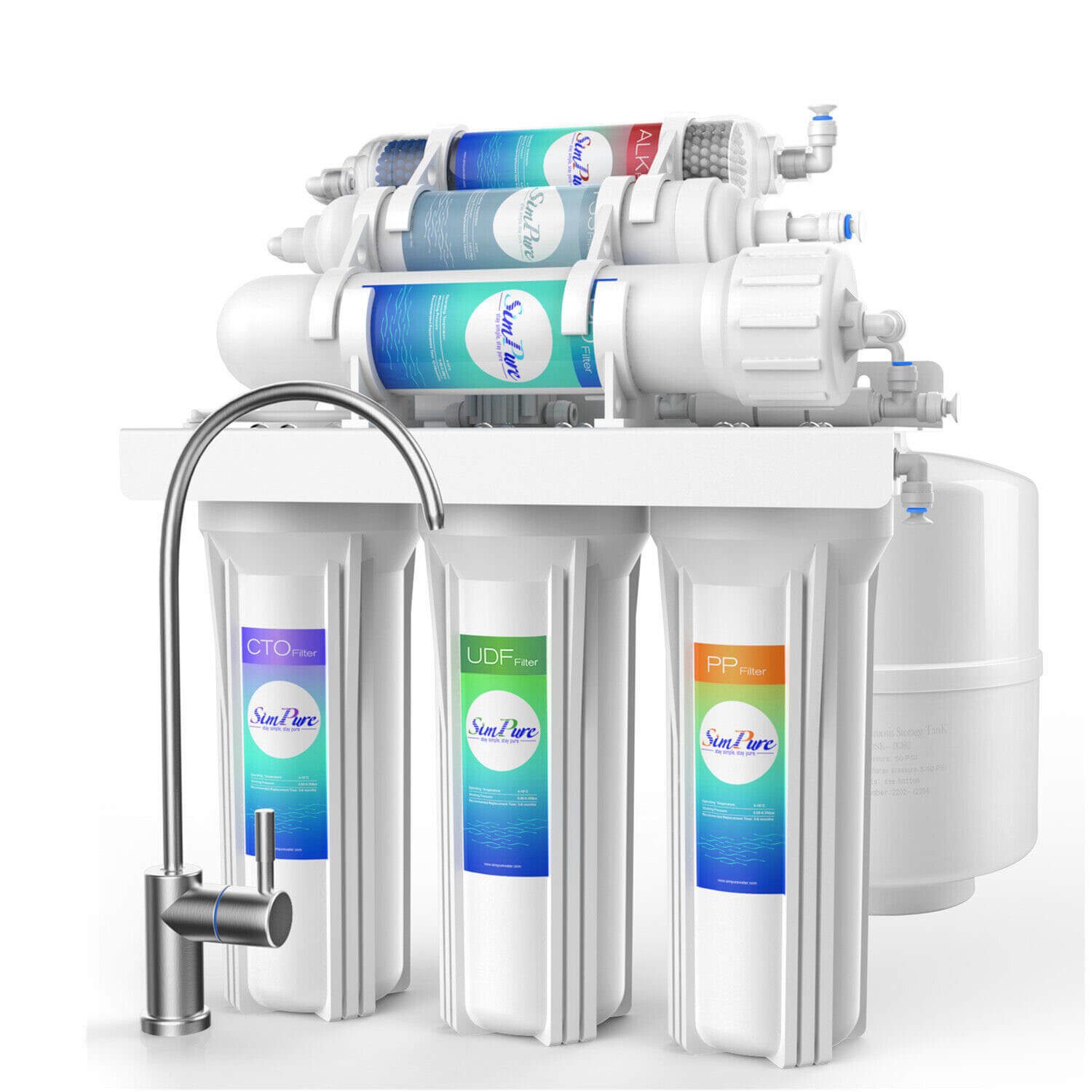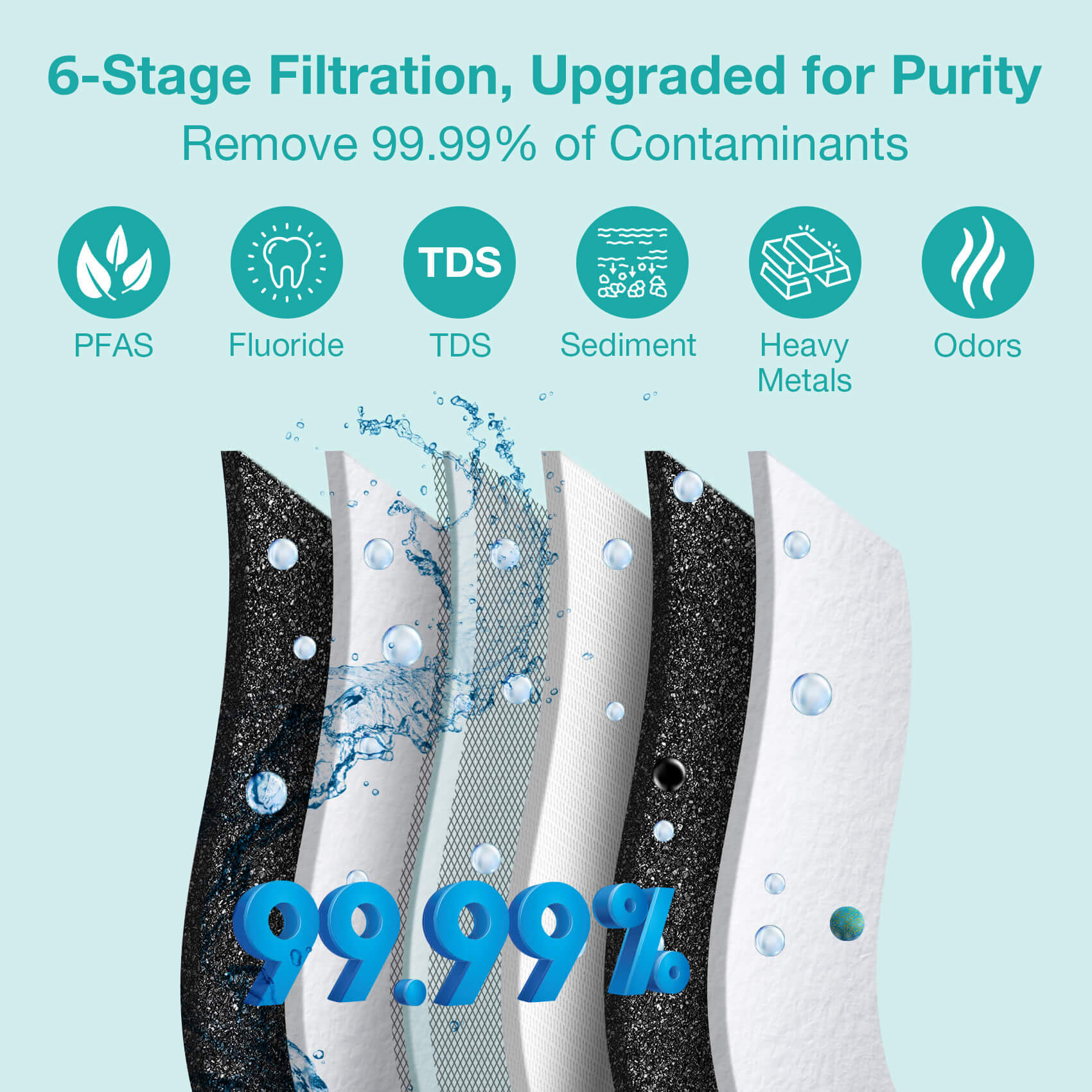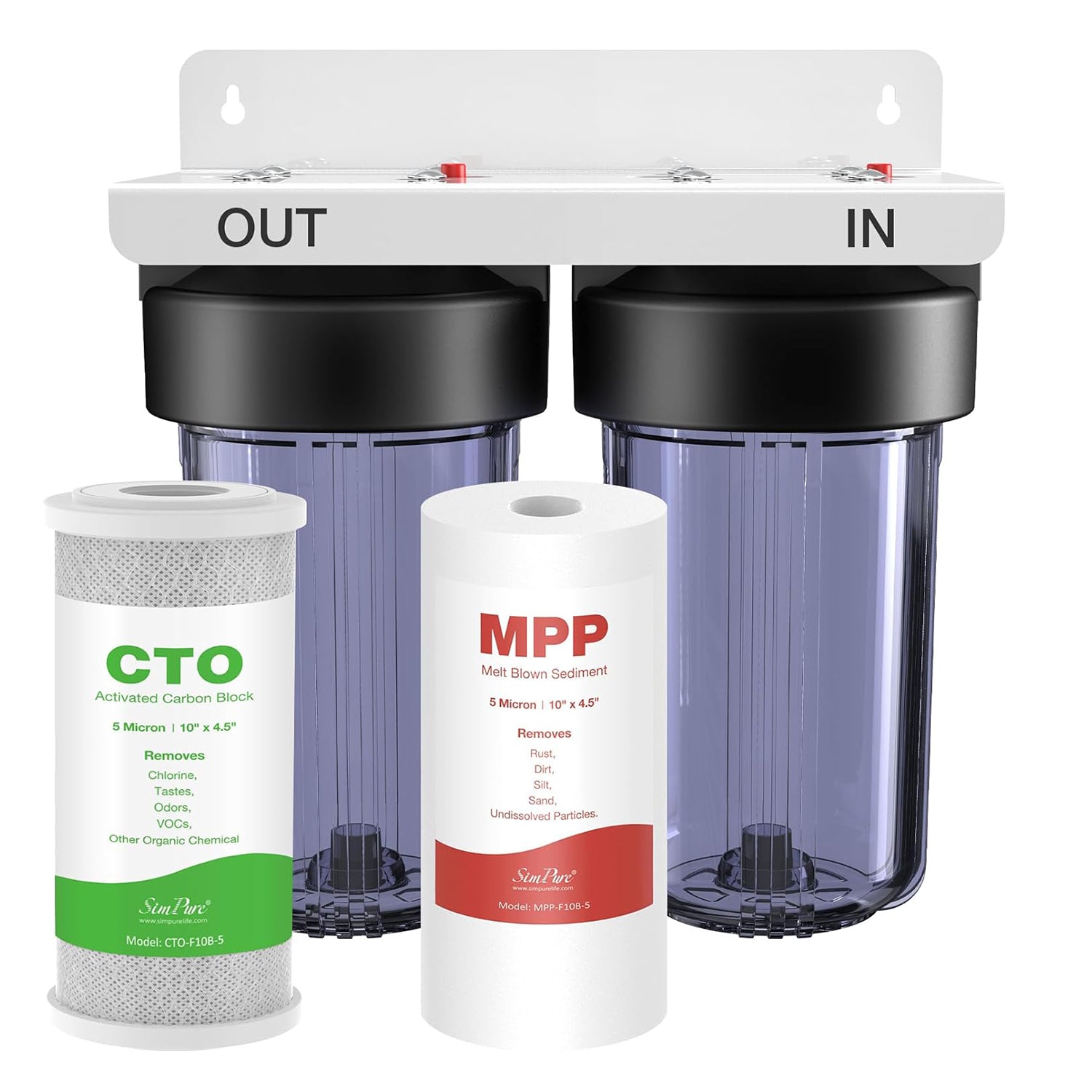


The best RO water filter system is not one universal model. It is the system whose exact reduction claims match your water, whose format fits the installation, whose real dispensing performance meets your routine, and whose reject-water and service costs you can document before purchase.
That definition changes the shopping process. Do not begin with a brand ranking, stage count, gallons-per-day headline, or TDS display. Begin with a seven-field RO fit card, reject candidates with missing evidence, and compare trade-offs only among the systems that pass. This guide covers countertop, conventional tank under-sink, and direct-flow under-sink formats. When the shortlist is limited to cabinet-installed systems, repeat the same evidence gates with the cabinet, drain, faucet, outlet, tank, and service route measured in place.
Product pages, availability, and specifications cited here were checked on August 24, 2026. They are first-party product fields, not independent proof of contaminant reduction, and they can change.
The “best” answer is a completed RO fit card
A useful comparison has seven fields. The first four determine whether a system can do the job; the last three determine whether the household can keep it doing the job. A blank field is not a small disadvantage—it is an unresolved purchase risk.
| Fit-card field | Evidence to record | Reject the candidate when |
|---|---|---|
| 1. Water problem | Water source, current report or test, substance, concentration, sampling date, and treatment objective | The seller substitutes “pure water” for a defined problem |
| 2. Reduction evidence | Exact model, exact contaminant claim, standard or test, certifier or laboratory, rated conditions, and capacity | A badge, stage count, or membrane size appears without the exact claim |
| 3. Format boundary | Counter or cabinet dimensions, cold-water and drain access, outlet, faucet hole, feed-tank handling, and refrigerator route | The installation cannot be completed or serviced in the available space |
| 4. Water delivery | Membrane production capacity, faucet or dispenser flow, usable stored volume, refill/recovery behavior, and peak-use test | GPD is presented as though it were the faucet flow |
| 5. Water efficiency | Pure-to-drain or drain-to-pure ratio with direction stated, test conditions, flush behavior, and complete-cycle basis | The ratio direction or measurement boundary is missing |
| 6. Ownership route | Every replacement part, evidence-based interval, current cost, sanitation task, electricity, warranty, and local service access | Proprietary filters or required service parts cannot be sourced predictably |
| 7. Last outlet | Dedicated faucet, pitcher, refrigerator, ice maker, coffee equipment, daily volume, and acceptable wait or refill behavior | The system cannot reliably supply the place and pattern in which the water will be used |
This is a pass/fail card, not a weighted score designed to manufacture a winner. A candidate that fails the defined contaminant claim should not recover points because it is compact or inexpensive. Only after every required field passes should convenience, aesthetics, and price break the tie.
First decide whether RO is the right treatment job
RO is a point-of-use treatment process, not a default upgrade for every tap. CDC home water-treatment guidance advises households to test their water, choose treatment for the harmful chemicals or germs of concern, and check the exact product label. It also notes that a home treatment system may not be needed when the tap water does not contain the harmful substances being targeted. That is the first decision gate, not a footnote.
For public water, start with the current Consumer Confidence Report, then investigate a building-specific concern when plumbing, a private service line, taste, or a local event could make the utility-wide report incomplete for the tap. For a private well, use an accredited or otherwise appropriate laboratory and follow state or local testing guidance. Record the sample point, method, units, detection limit, and date. A handheld TDS meter is not a substitute for a contaminant-specific laboratory result.
The EPA defines point-of-use RO as pressure-driven separation through a semipermeable membrane, producing treated permeate and a reject stream. It also says RO should not be promoted for every application: in some cases, treatment that uses little or no reject water is sufficient. If the defined concern is only chlorine taste at one faucet, for example, a verified carbon claim may solve the job with less water and equipment. If the problem is hardness scale throughout the home, a drinking-water RO system does not replace whole-home hardness treatment.
Choose the format before comparing models
Countertop, conventional tank under-sink, and direct-flow under-sink systems all use RO, but they create different household jobs. Comparing them in one ranked list without accounting for installation and delivery hides those differences.
| Format | Useful when | Verify before buying | Common operational cost |
|---|---|---|---|
| Countertop with feed tank or pitcher | Fixed plumbing changes are undesirable or impossible | Counter footprint, overhead clearance, refill weight, batch volume, dispenser flow, outlet, and cleaning access | Manual filling, tank washing, counter space, and waiting between batches |
| Under-sink with pressure tank | Stored water and a dedicated faucet fit the cabinet and use pattern | Cabinet envelope including tank, feed pressure, drain and faucet work, usable draw, recovery, sanitizing, and refrigerator compatibility | Tank space, pressure-dependent draw, periodic tank sanitation, and more plumbing connections |
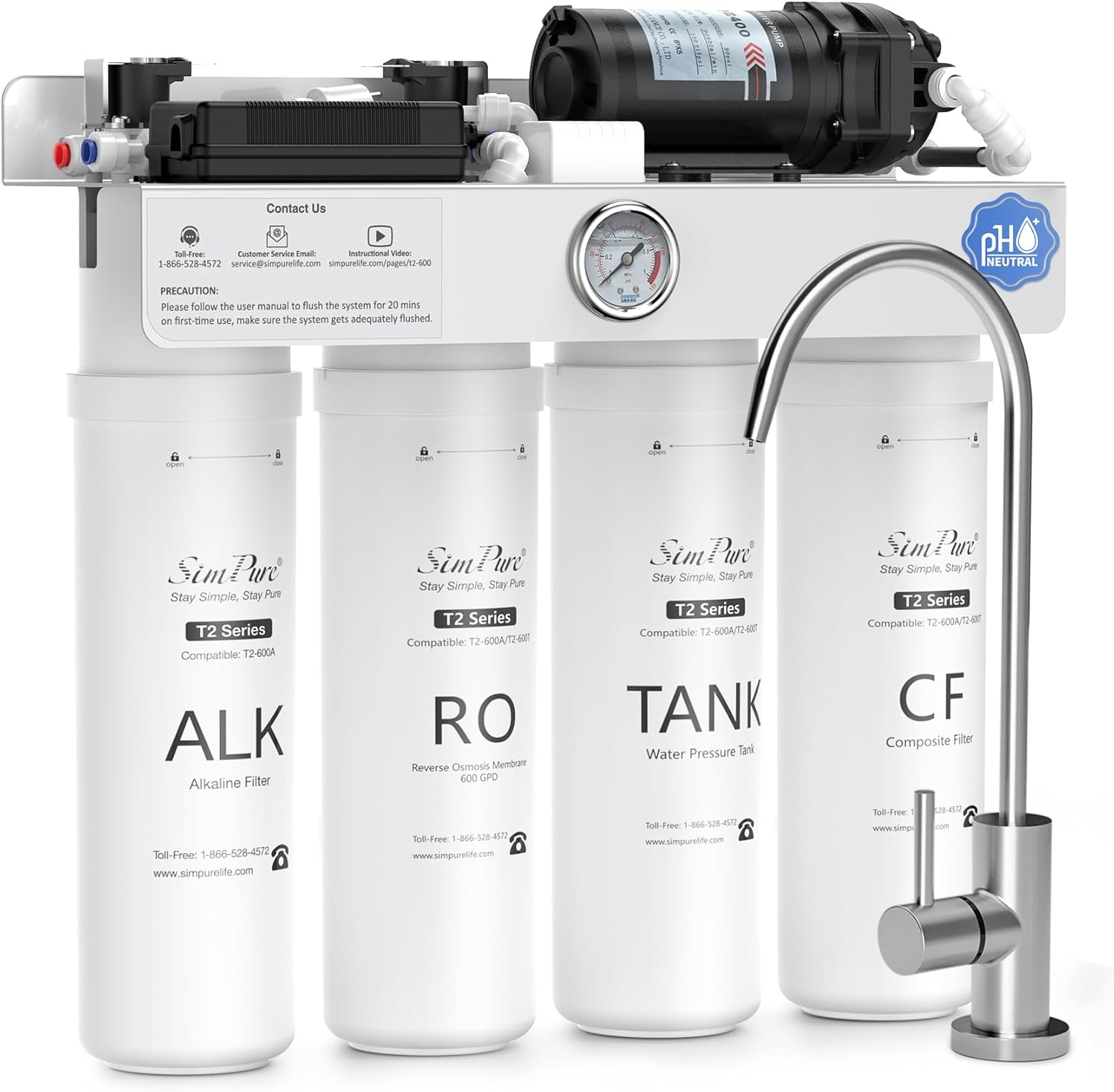
| Direct-flow or “tankless” under-sink | Cabinet width is limited and on-demand production can meet peak use | Actual faucet flow, inlet range, power outlet, pump noise, flushing behavior, drain route, and whether another device requires a buffer tank | Electricity, pump operation, proprietary cartridges, and possible accessories for refrigerators or ice makers |
A countertop system trades plumbing work for handling work
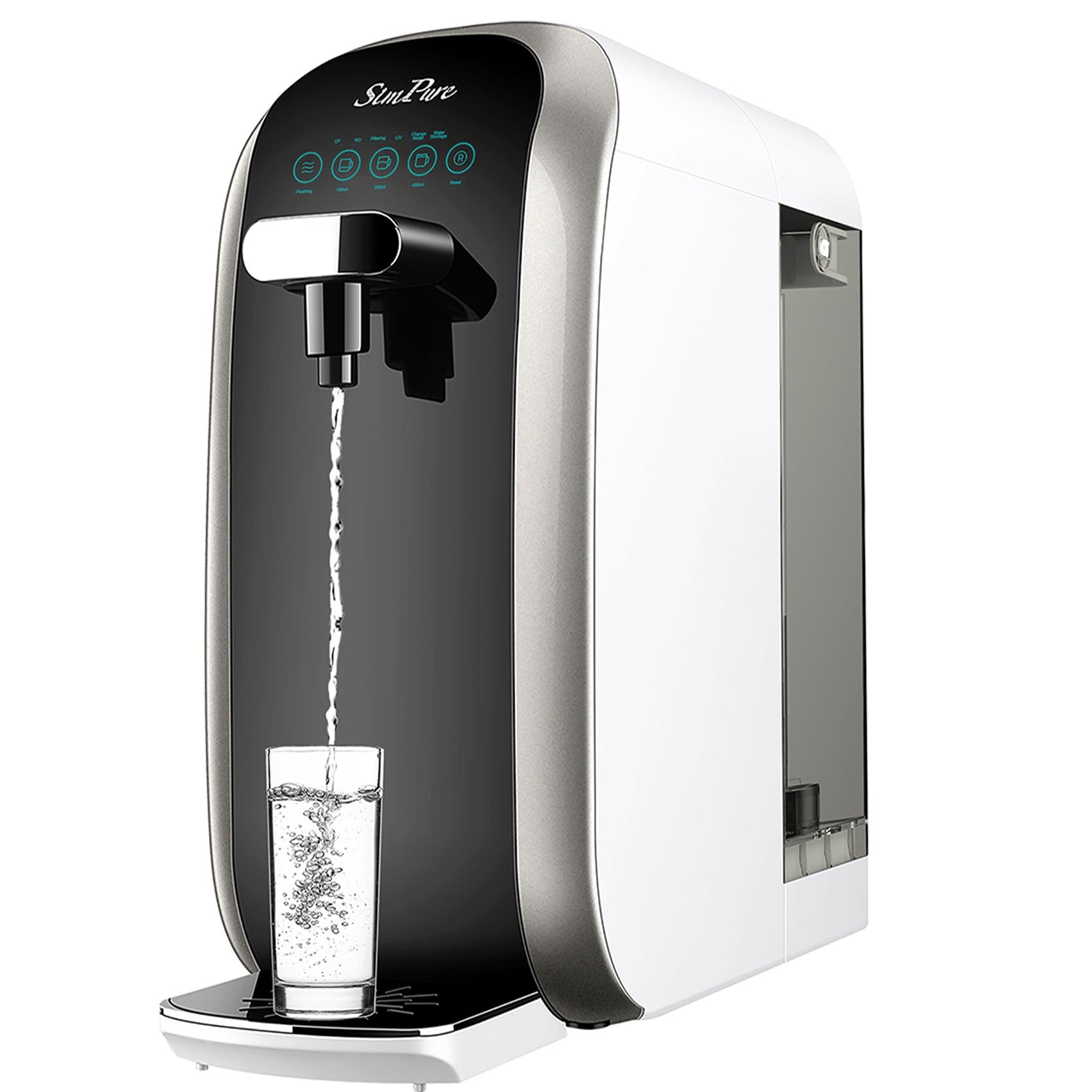
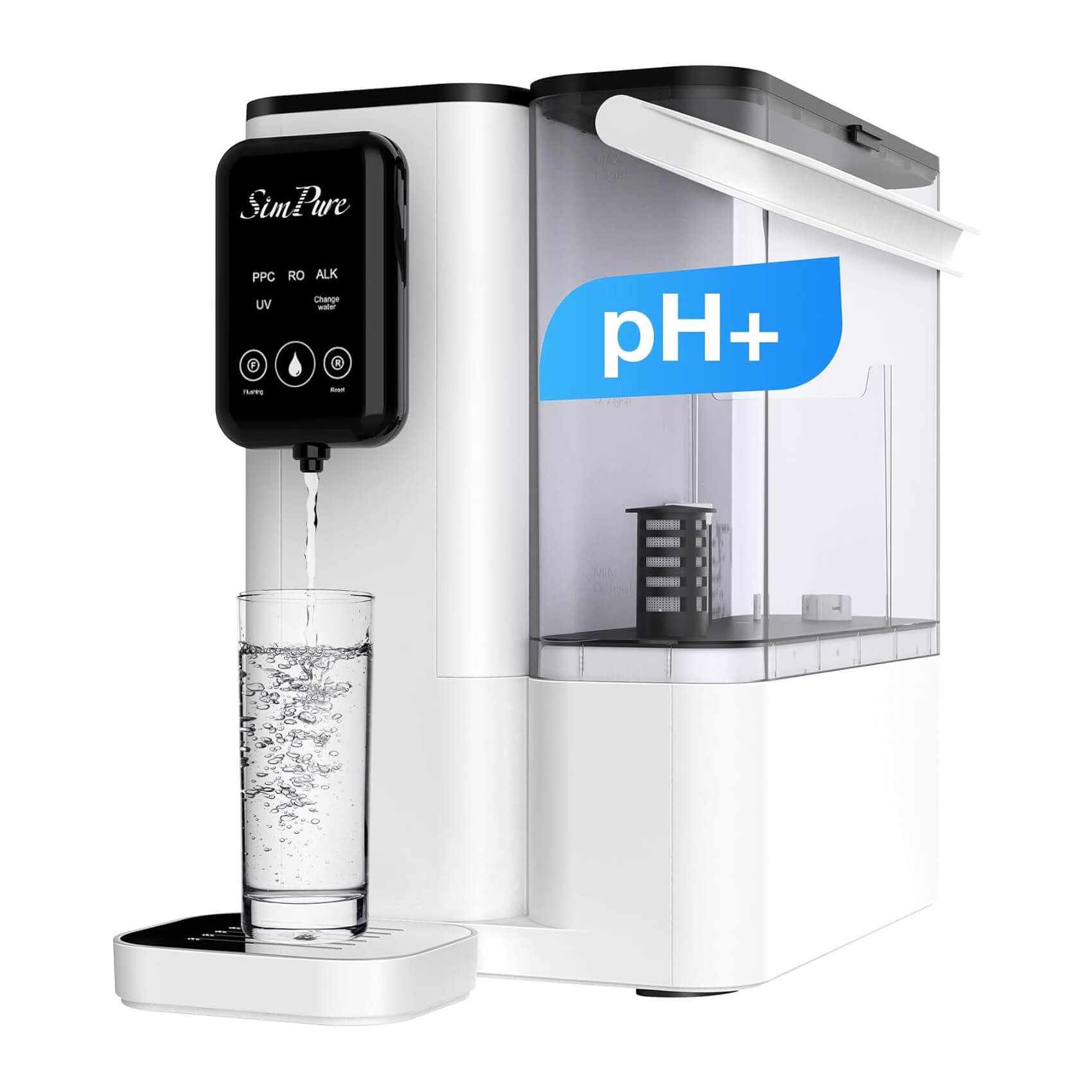
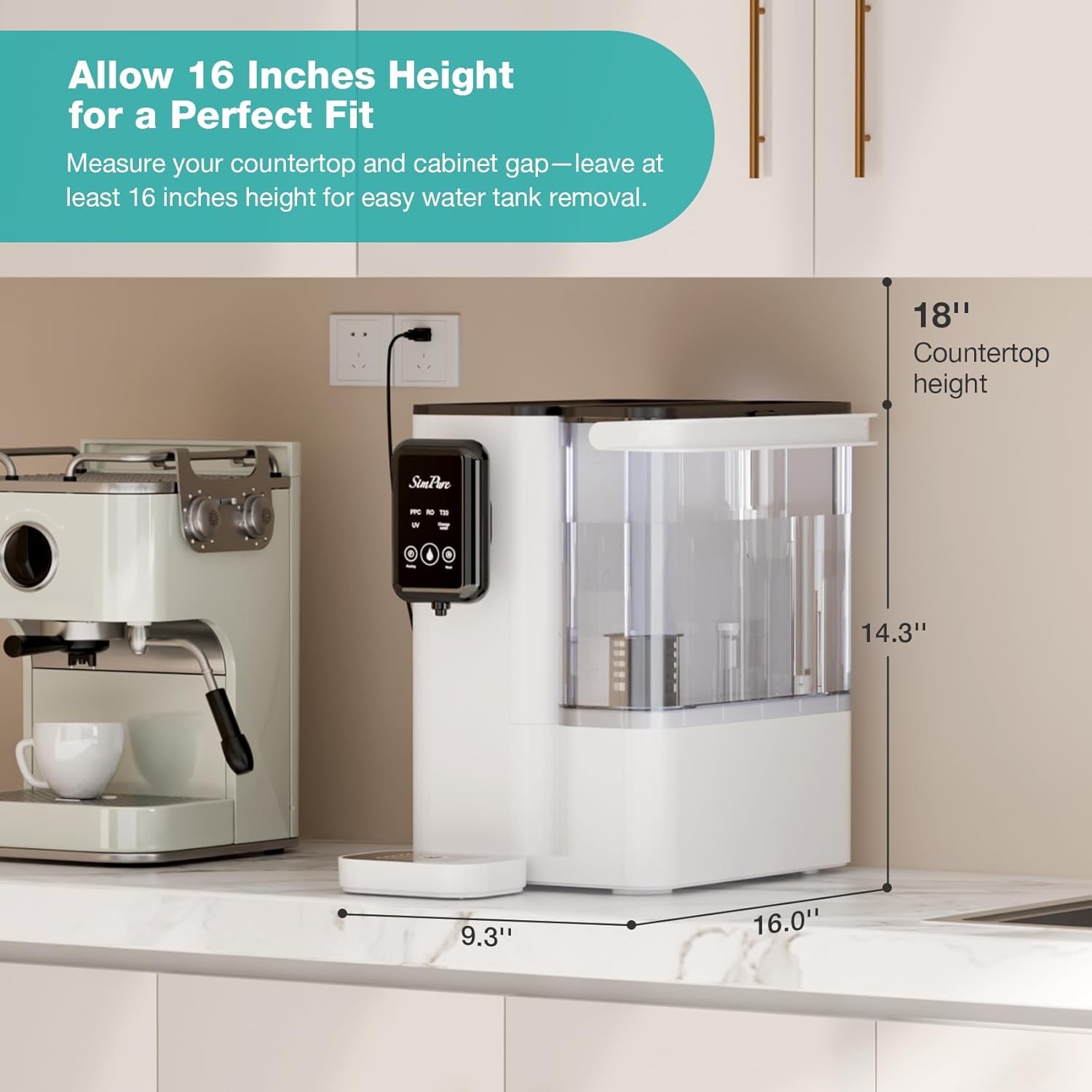
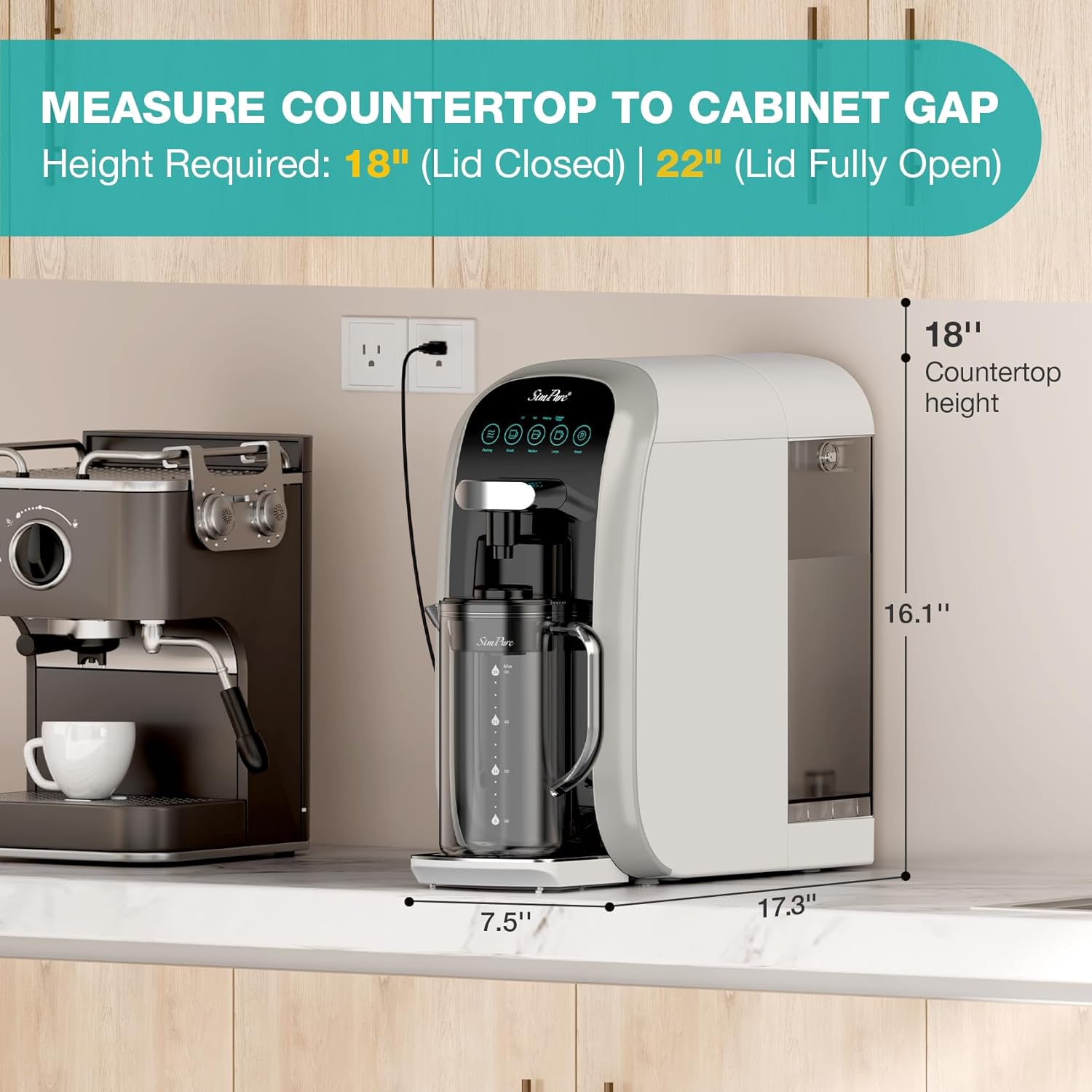
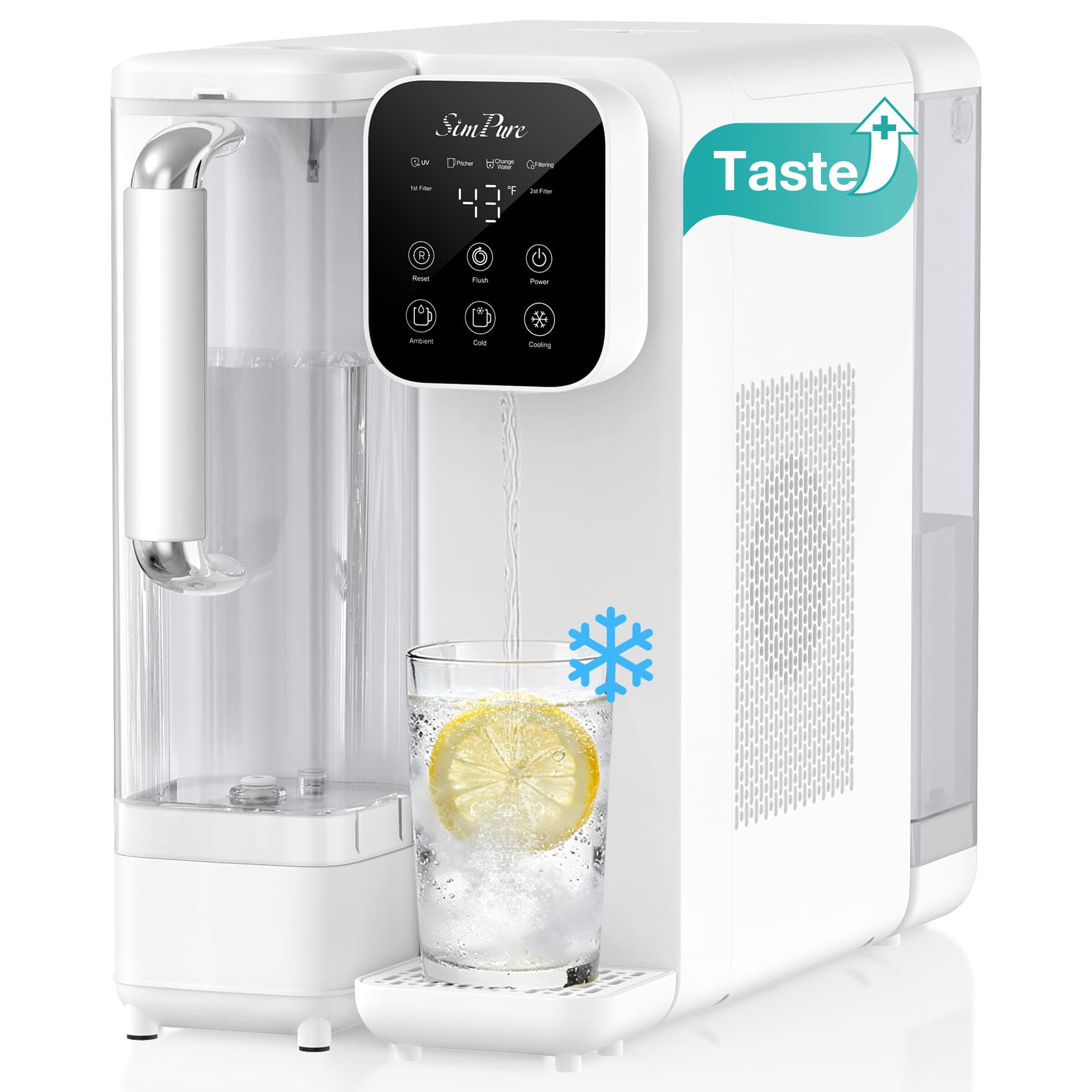
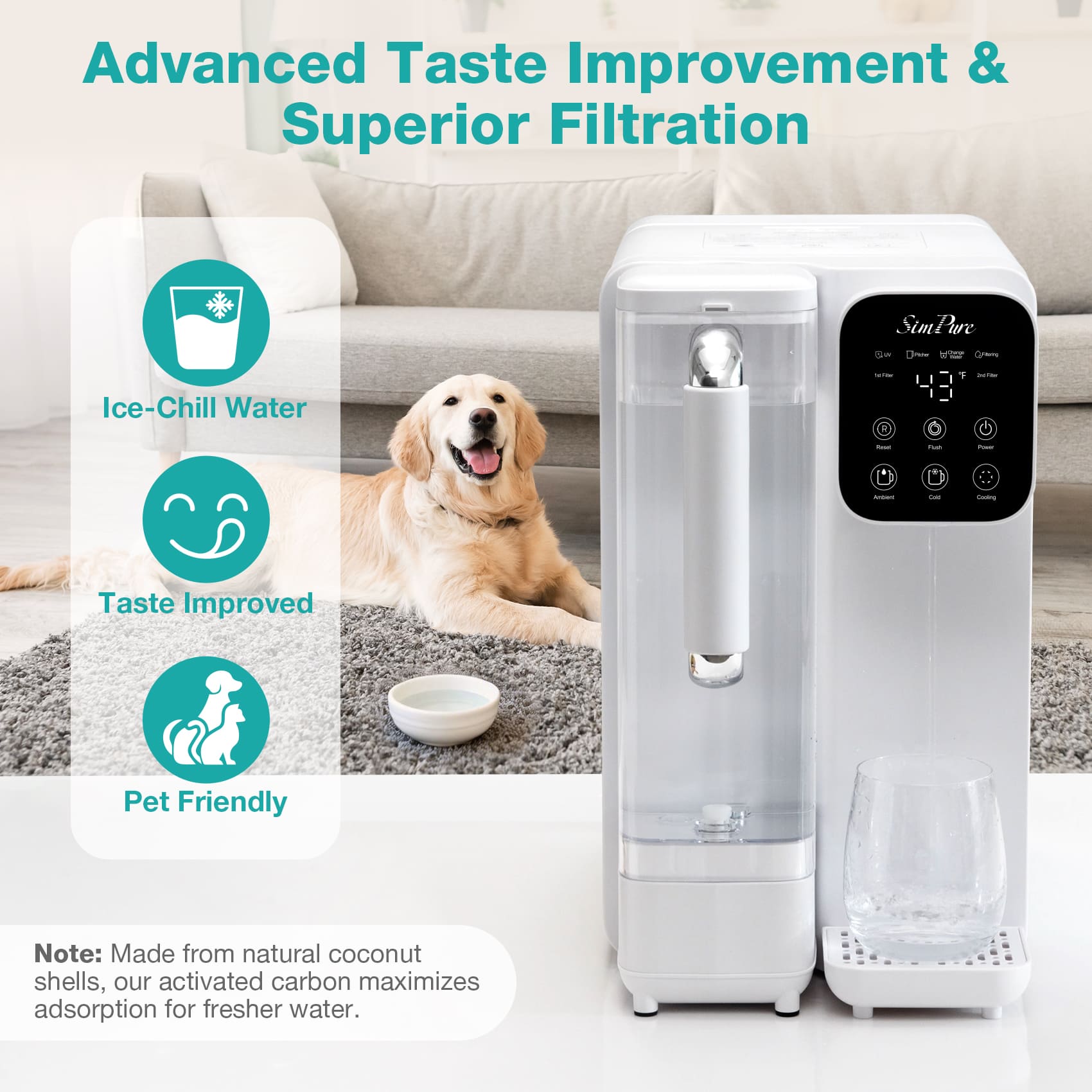
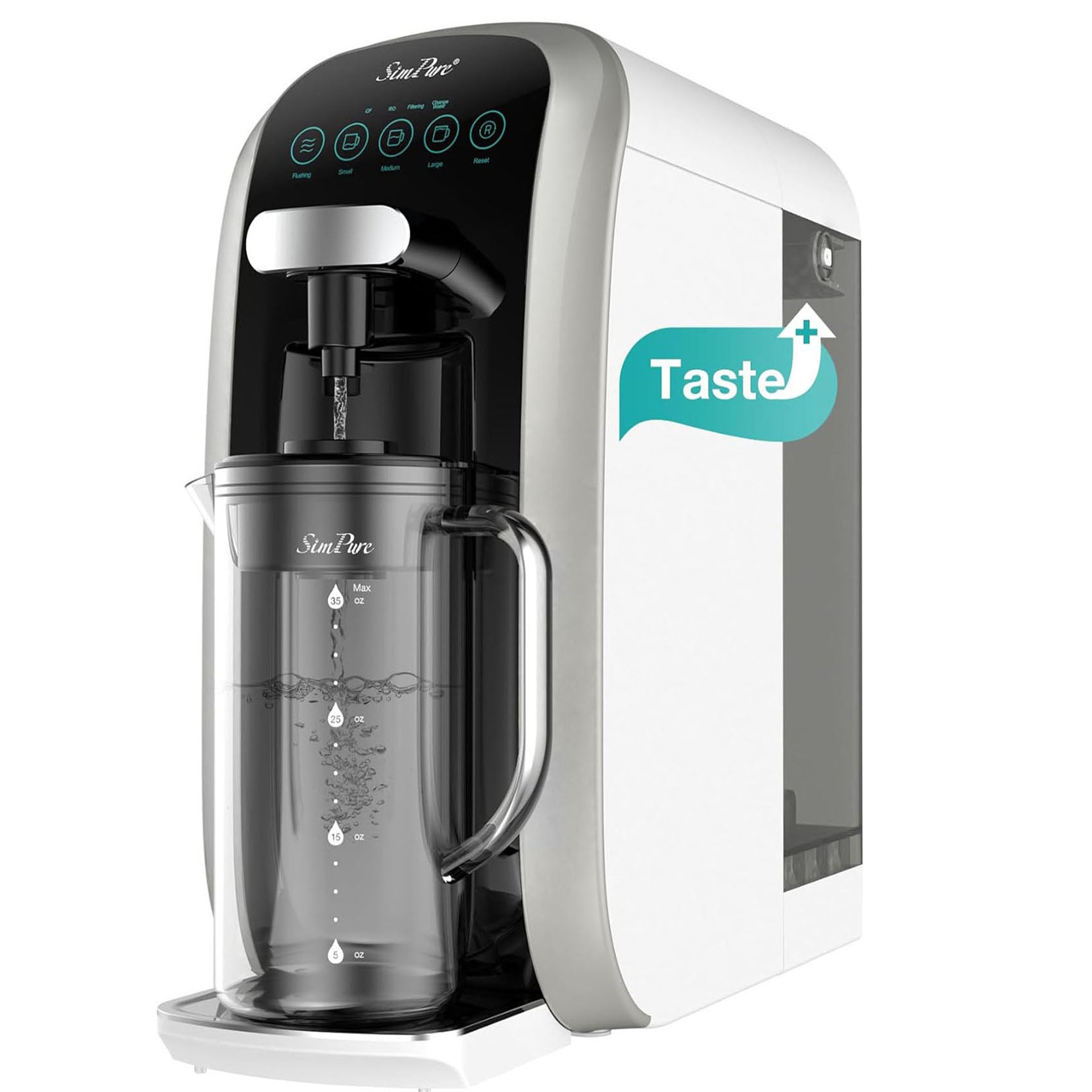
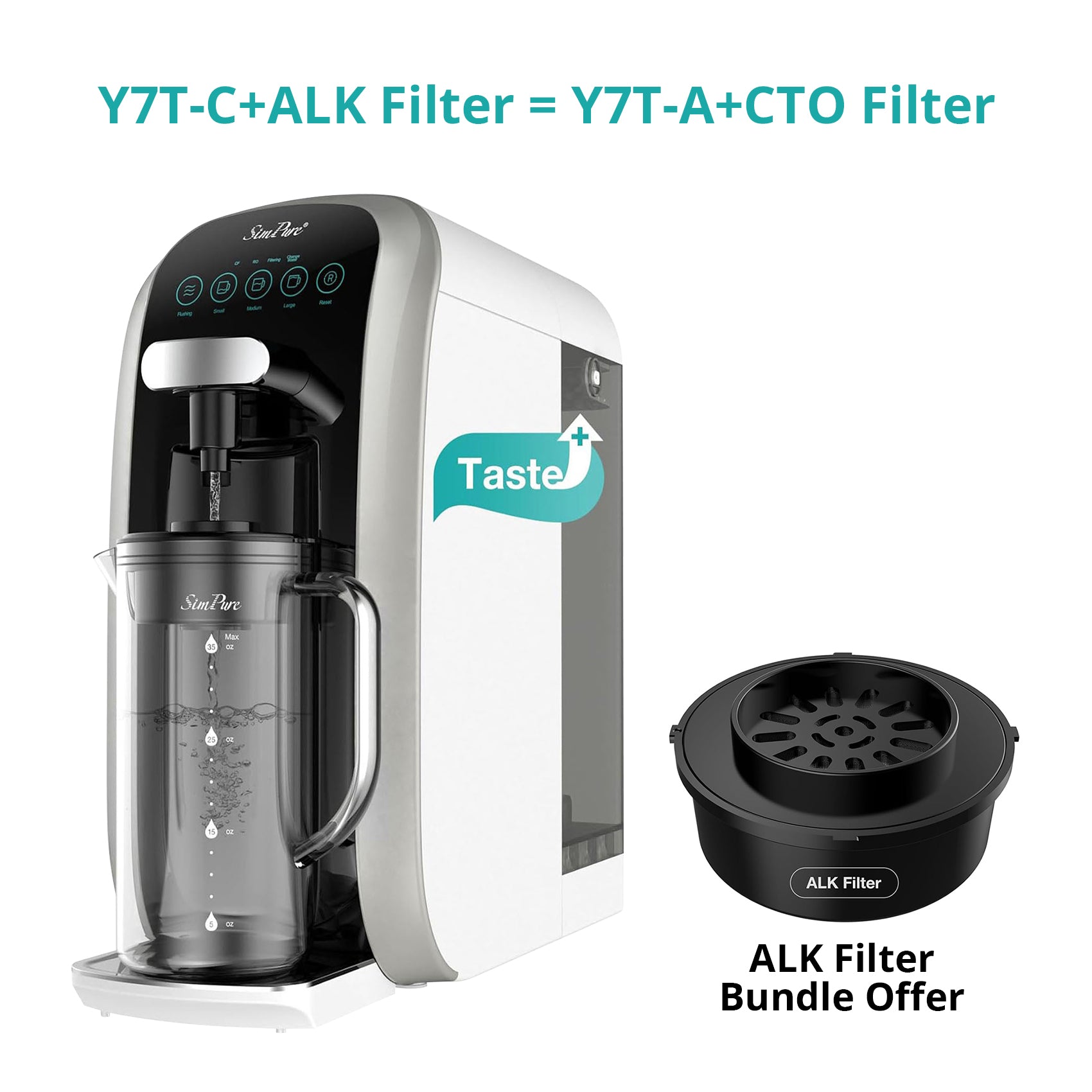
The current SimPure Y7T-A product record lists a pre-installed countertop configuration with a removable glass pitcher. Its stated dimensions are 17.3 by 7.5 by 16.1 inches, and it requires electricity. Those facts help a renter or homeowner test counter depth, outlet location, pitcher clearance, and refill workflow before comparing treatment claims.

Do not interpret “no installation” as “no fit check.” Measure the counter with cabinets and appliance doors in their real positions. Confirm that the filled feed tank and pitcher can be lifted safely, that the unit can be cleaned without moving other appliances, and that rejected water is handled as the manual directs.
Separate four numbers sellers often blur together
RO listings commonly place production, delivery, storage, and efficiency near one another. They are not interchangeable.
- Membrane production capacity (GPD) is a rated daily production value under defined conditions. Temperature, pressure, feed-water chemistry, and system controls can change real output.
- Faucet or dispenser flow is the rate the user experiences while filling a glass or pot. The current Y7T-A page, for example, lists both 100 GPD capacity and an 8.8-ounce-per-minute dispenser flow. Those two numbers answer different questions.
- Usable stored volume is the water available before pressure or level falls enough that the system must recover. A nominal tank size is not automatically the usable draw volume.
- Water-efficiency ratio compares treated water with reject water. Its direction must be written every time.
A listed 1.5:1 pure-to-drain ratio means 1.5 units of treated water for one unit of reject water. The same relationship written drain-to-pure is about 0.67:1. Reversing the labels reverses the apparent result. Also ask whether the ratio covers a complete operating cycle, including flushing, tank effects, and recirculation. SimPure’s separate RO wastewater guide shows how to normalize ratios and estimate household reject volume.
EPA’s current WaterSense criteria provide an independent efficiency benchmark: a labeled point-of-use RO system must send no more than 2.3 gallons to drain per gallon of treated water and must meet specified performance criteria. A seller’s ratio is not a WaterSense label. Verify the exact model in the program directory before assigning that status.
Read reduction evidence one claim at a time
NSF’s water-treatment standards guide explains that NSF/ANSI 58 applies to reverse osmosis systems, while also warning that certification to a standard does not mean a product reduces every possible contaminant. The standard number is not a quality rank. For each substance on the fit card, verify the exact model, exact reduction claim, rated capacity or life condition, and the organization that certified or tested it.
A defensible claim ledger should contain:
- the model number on the product and the model in the certificate or report;
- the exact contaminant or surrogate—not “1,000+ contaminants” as a category;
- the standard, protocol, laboratory, and current directory or report;
- influent concentration, pressure, temperature, flow, recovery, and other stated test conditions;
- the rated capacity, replacement condition, and any required pre- or post-treatment;
- the date checked and a saved source location that can be rechecked later.
Stage count is a plumbing description, not performance proof. Two stages can perform different jobs, or several seller-defined “stages” can occur inside one cartridge. Likewise, TDS is a broad conductivity-based indicator; it does not identify every chemical, prove microbial safety, or confirm a specific contaminant claim. Use it for the limited monitoring job supported by the exact system instructions, not as a universal safety score.
Price the service route before the system
The purchase price is only the first line of ownership. Build a three-year parts and work record before comparing value:
- every prefilter, postfilter, membrane, remineralization cartridge, tank filter, lamp, seal, and sanitation supply;
- the manufacturer’s maximum time or capacity limit and the household observation that may trigger earlier service;
- shipping, electricity, reject water, plumber work, faucet drilling, refrigerator kits, and any pressure or pretreatment equipment;
- the time and clearance needed to isolate, depressurize, replace, flush, sanitize, inspect for leaks, and document the service;
- current availability of exact replacements and a plan for a discontinued proprietary cartridge.
Turn those fields into a three-year ownership worksheet and a model-specific service record. A cheaper system with unavailable cartridges or an impractical sanitation route is not a lower-cost system.
Three current SimPure configurations show why fit changes
The following examples are not a ranking and do not transfer a reduction claim from one model to another. They show how format and delivery fields change while all three products remain in the RO category.
| Configuration | Current first-party fields | Fit question it answers | Unresolved evidence to verify |
|---|---|---|---|
| Y7T-A countertop | 100 GPD capacity; 8.8 oz/min listed dispenser flow; 17.3 × 7.5 × 16.1 in; removable pitcher; electricity required; 4:1 pure-to-drain listed | Can the household accept counter space and manual handling instead of fixed plumbing? | Exact claim evidence, complete-cycle efficiency, real batch output, refill frequency, and cleaning workload |
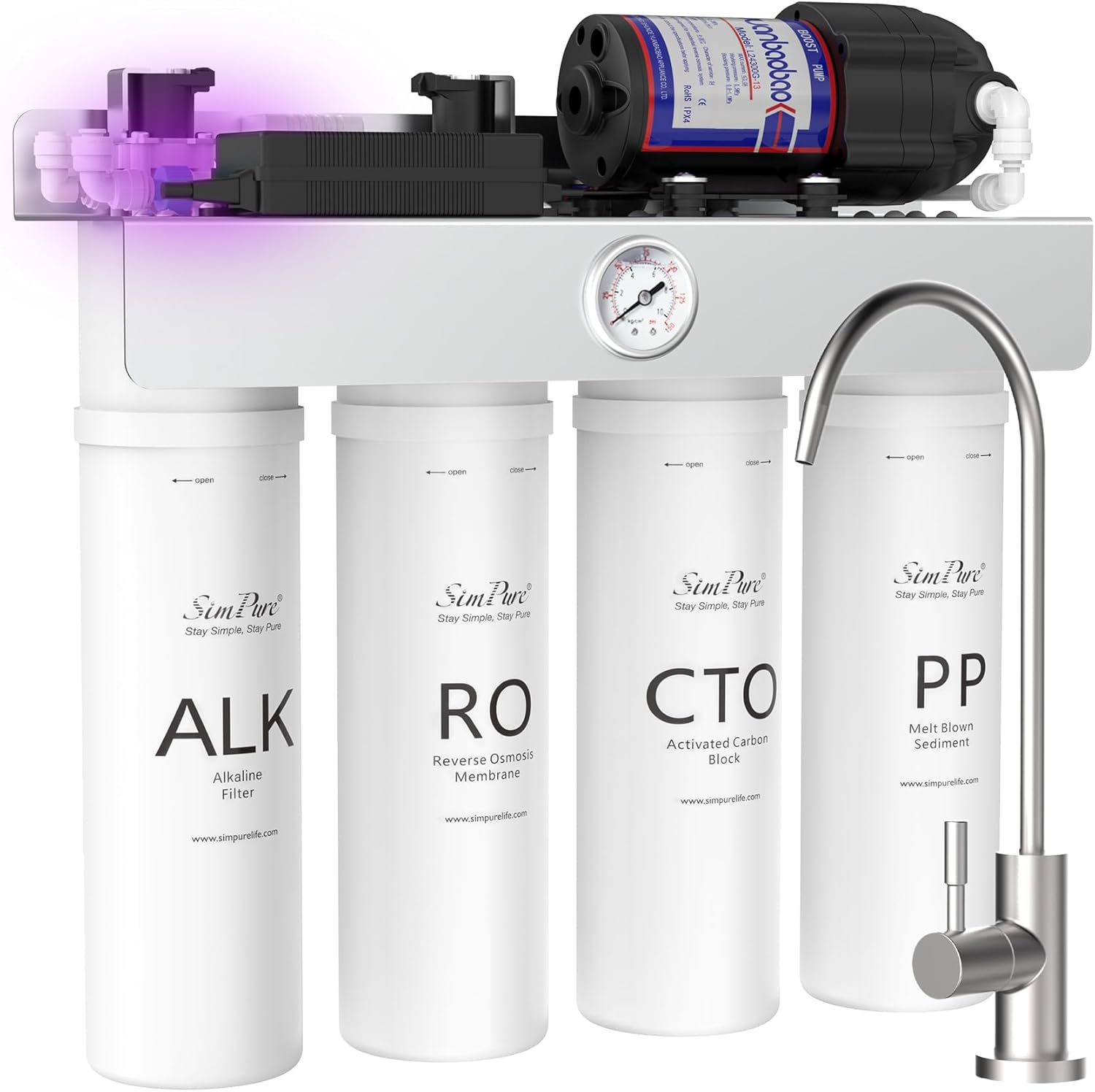
| T1-100 under-sink with tank | 100 GPD maximum production; 2.5-gallon pressure tank; 15–60 psi listed feed range; 15.55 × 5.31 × 15.94 in system body; electricity required | Will stored delivery, the separate tank, and the cabinet service envelope fit better than direct flow? | Usable tank draw, recovery under household conditions, exact claim evidence, sanitation route, and refrigerator accessory details |
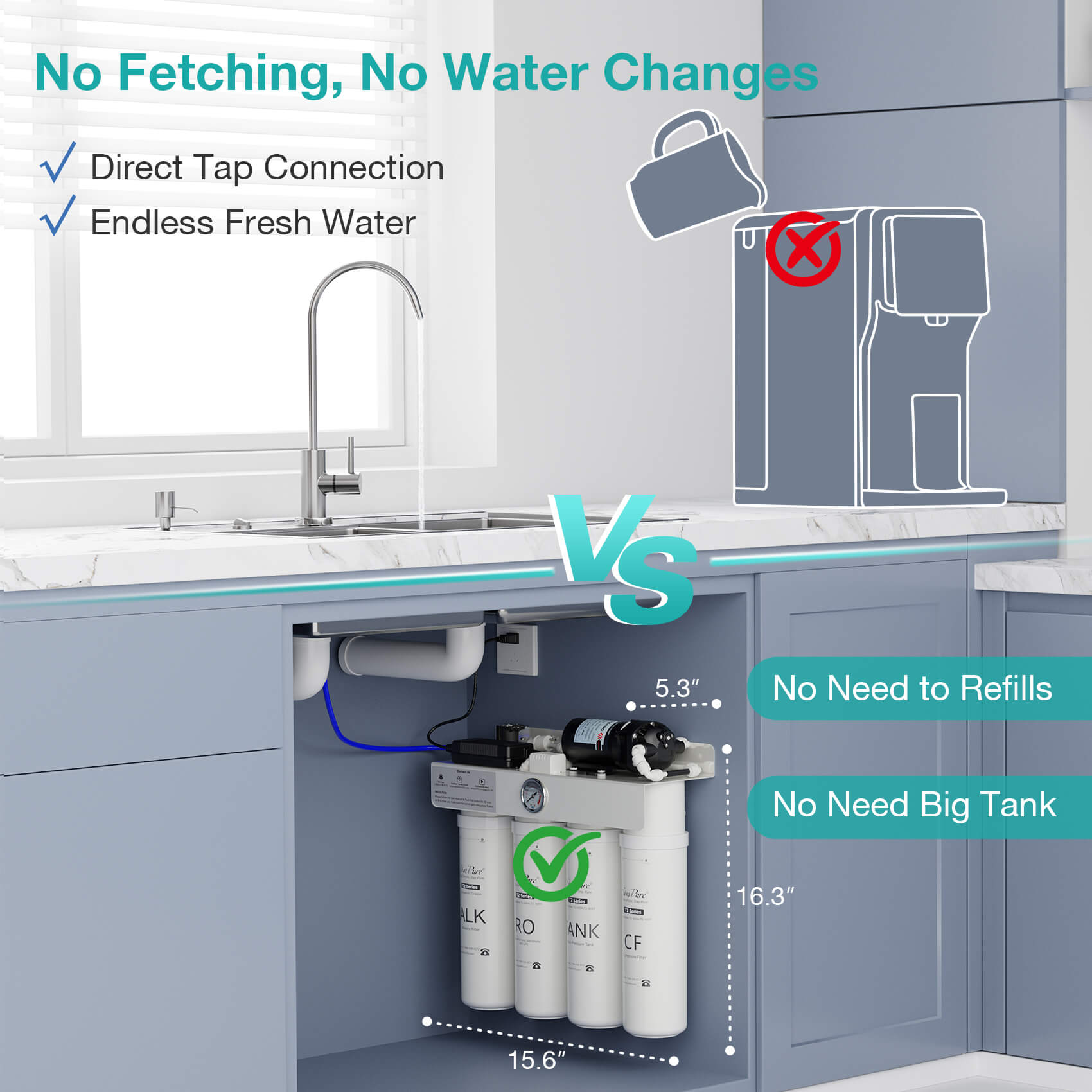
| T1-400 direct-flow under-sink | 400 GPD capacity; 0.28 gal/min listed faucet flow; 15.6 × 5.3 × 15.7 in; electricity required; no pressure tank in the base configuration; 1.5:1 pure-to-drain listed | Can on-demand delivery meet peak use while preserving cabinet space? | Exact claim evidence, flow and efficiency at site conditions, pump sound, flush behavior, and the extra tank requirement for refrigerator or ice-maker service |
A pressure-tank system needs a two-part cabinet measurement
The current T1-100 product record separates the 15.55-by-5.31-by-15.94-inch filter body from a 2.5-gallon pressure tank. The cabinet check therefore includes both components, tubing bend radius, shutoff access, filter-removal movement, tank valve access, and the items the household already stores below the sink.

The T1-400 removes the separate storage tank from its base configuration, but it adds direct-flow dependence on a pump and electricity. Its current page also notes that refrigerator or ice-maker connection requires an extra pressure tank that is not included. “Tankless” therefore does not automatically mean the whole household route is tank-free.
Use two passes to select a finalist
Pass one: apply the non-negotiable gates
- Write the water source, current test or report, exact concern, and desired treated outlet.
- Verify the exact contaminant claim for the exact model. If it is missing, reject the model for that job.
- Check feed-water pressure, temperature, TDS or other limits, and pretreatment requirements against site conditions.
- Draw the installation: counter or cabinet footprint, cold feed, drain, outlet, faucet, tank, refrigerator, leak containment, and service clearance.
- Confirm that real dispensing and storage behavior passes a peak-use trial or a credible model-specific specification.
- Normalize the efficiency ratio and identify the full-cycle test boundary.
- Complete the parts, cost, sanitation, and replacement-availability record.
A single failure ends the comparison. Do not average an unsupported health claim with a good warranty or attractive price.
Pass two: resolve the household trade-offs
Among candidates that pass, choose the trade-off the household can operate consistently. A countertop system may be best for a rental even when it occupies visible space. A pressure-tank system may be best for short bursts or a refrigerator route when the cabinet can hold and sanitize the tank. A direct-flow system may be best when cabinet volume is constrained and the listed faucet flow passes the household’s pot-filling test.
Document why the winner was chosen in one sentence: “This model passes the exact claim and site limits, and we accept this operational cost to gain this household benefit.” That sentence is more durable than a generic “best overall” badge.
When the best RO system is no RO system
- No defined treatment need: testing and the current water report do not identify a concern that requires RO.
- A lower-burden technology has the exact claim: carbon or another treatment can address the concern without a reject stream.
- The problem is whole-home: hardness, sediment, iron, or another premise-wide issue needs treatment sized for the main line rather than one drinking outlet.
- The source is outside the model’s limits: high sediment, hardness, iron, temperature, pressure, or other chemistry requires pretreatment or a different design.
- A boil-water advisory or acute event is active: follow the issuing authority’s instructions; do not infer emergency protection from an ordinary RO label.
- The service route will fail: cartridges, sanitation, electricity, drainage, or replacement parts cannot be maintained reliably.
The best RO water filtration system is the candidate that survives the seven-field fit card and creates the least operational friction for the actual home. Start with the water problem, make every claim model-specific, separate GPD from delivery, normalize the efficiency ratio, and measure the complete installation. Only then use SimPure’s reverse osmosis collection as a shortlist.
Frequently Asked Questions
Which RO filter brand is best?
No brand is best for every water source and household. Compare exact model-level contaminant claims, current certification or test evidence, feed-water limits, real delivery, water efficiency, replacement availability, and service support. A strong brand reputation cannot replace a missing claim for the substance you need to reduce.
What is a major downside of reverse osmosis water?
RO creates a reject-water stream and adds filters, maintenance, and operating conditions that must be managed. Some systems also need electricity, plumbing changes, storage space, or manual tank handling. EPA notes that inefficient point-of-use RO units can send several gallons to drain per gallon treated, so verify the exact model’s complete-cycle efficiency rather than assuming all RO systems waste the same amount.
Which RO product is best?
The best product is the one that passes your exact claim, site-limit, format, delivery, efficiency, and service gates. A countertop unit can be best when plumbing changes are impossible; a tank system can be best when stored delivery matters; and a direct-flow system can be best when cabinet space is scarce. None wins before the household conditions are specified.
Is RO the best water filtration system?
RO can be an appropriate point-of-use treatment when its exact certified claims match dissolved substances of concern. It is not automatically the best treatment for chlorine taste, hardness throughout a home, sediment loading, or every microbial event. Test the water, define the outlet and problem, and choose the lowest-burden technology with the required verified claim.