

How Often Should You Replace a Whole House Water Filter?
Most whole-house water filters need cartridge replacement every few months to a year, depending on the filter type, water quality, household consumption, and manufacturer's recommendations. There is no single schedule that applies to every system.
A sediment filter handling sandy well water may clog much sooner than one treating relatively clean municipal water. An activated carbon cartridge may still allow water to flow even after its ability to reduce chlorine and certain organic compounds has declined.
The best whole house water filter replacement schedule combines the manufacturer's service interval with actual operating conditions. Waiting until water pressure drops is not always enough, particularly when the filter is designed to reduce contaminants that cannot be seen or smelled.
Whole House Water Filter Replacement Schedule by Filter Type
The following table provides a starting point. Always check the instructions for your exact system and cartridge before setting a replacement date.
|
Filter type |
General replacement guidance |
What affects service life? |
|
Sediment filter |
Every 3–6 months is a common planning interval. |
Sediment concentration, particle size, and water usage |
|
Activated carbon filter |
Often 3–12 months, depending on the cartridge |
Chlorine levels, contaminant load, and total water volume |
|
Multi-stage cartridge set |
Follow the system's specified interval; some are rated for 6–12 months. |
Water conditions and the service life of individual stages |
|
Specialty media cartridge |
Follow the product-specific instructions. |
Target contaminant, media capacity, and operating conditions |
These ranges are not universal expiration dates. A cartridge exposed to heavy sediment may need replacement earlier, while another may remain within its rated capacity for longer. Use the product's stated service life and capacity limits rather than relying on a generic online schedule.
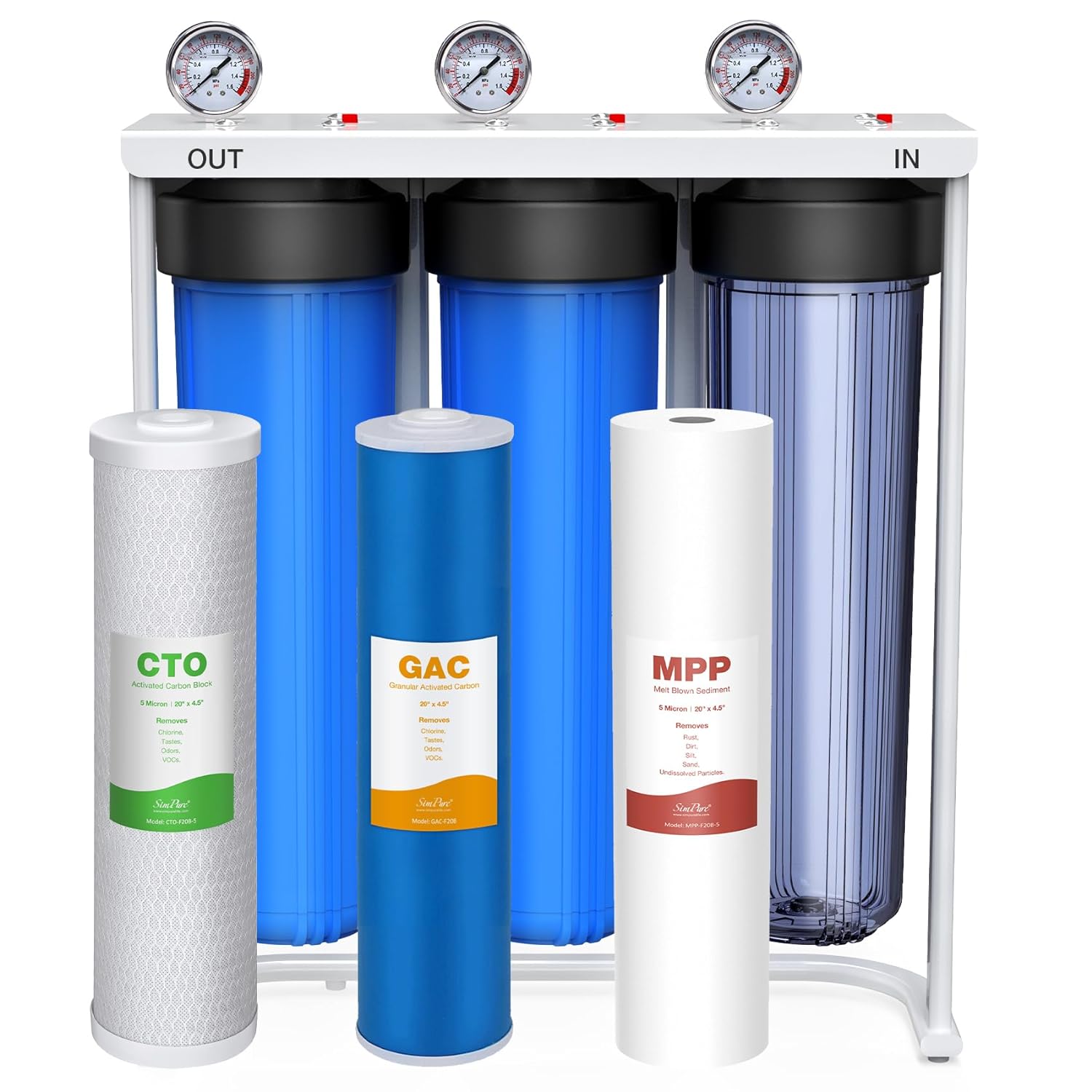
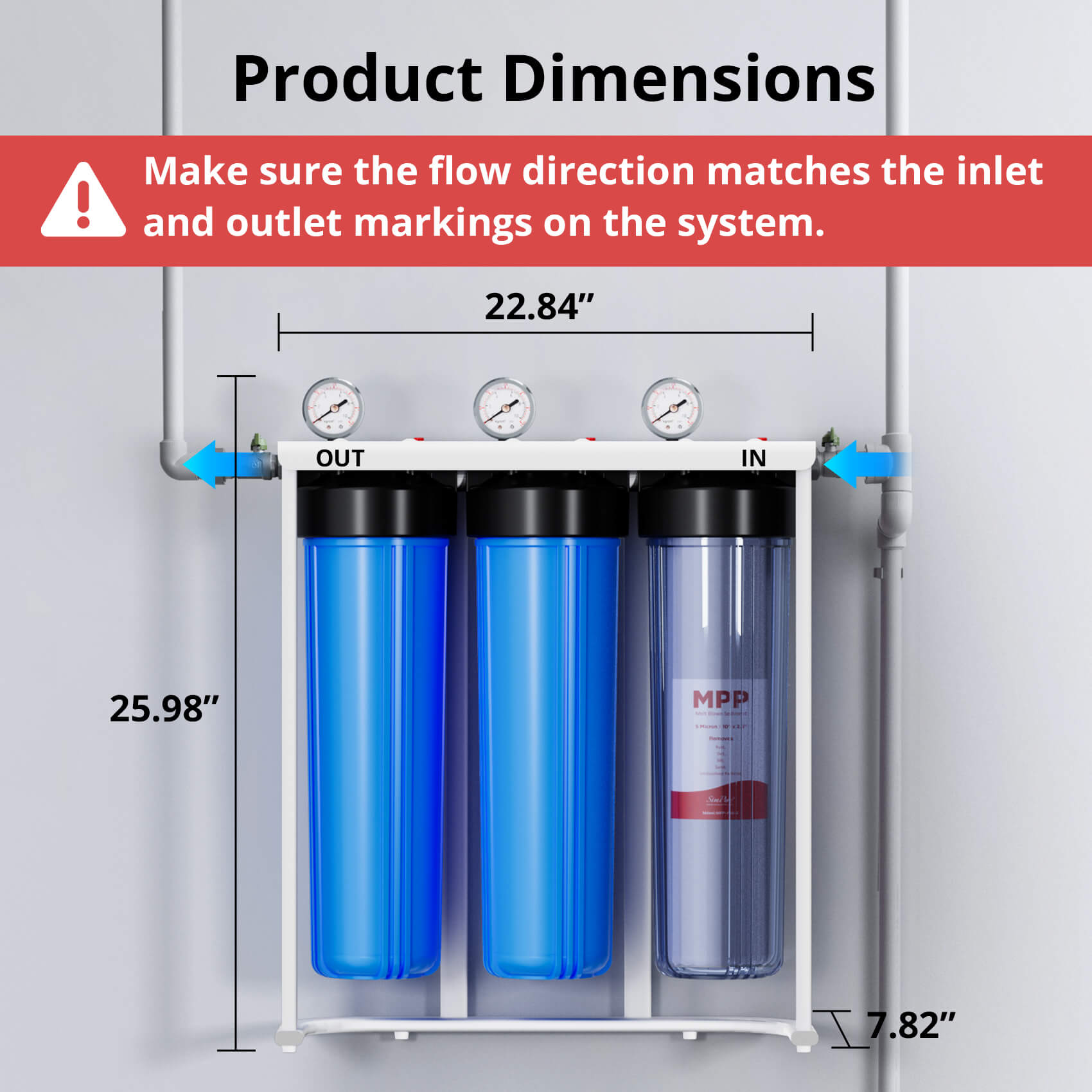
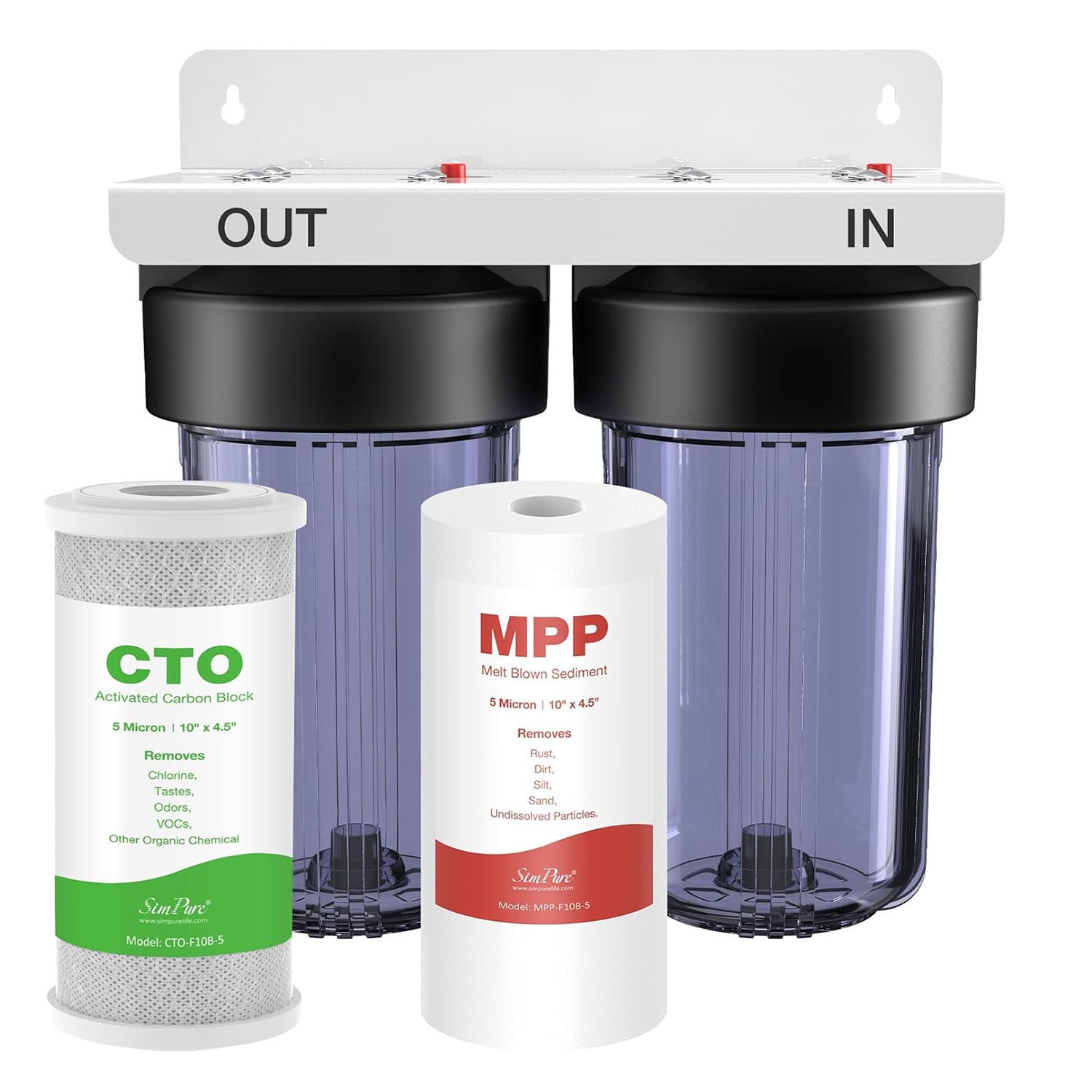
For example, the SimPure DB20P-3 whole house water filtration system lists a 6–12-month filter-life range. Its compatible replacement set gives a shorter 3–6-month recommendation depending on water conditions. This illustrates why the cartridge instructions and actual operating conditions should guide maintenance. 
Five Signs Your Whole House Filter May Need Replacing
1. Water Pressure Has Dropped
A noticeable decline in flow can indicate that a sediment cartridge has collected enough particles to restrict water movement. However, clogged plumbing, a failing pressure regulator, or another system problem can cause similar symptoms.
If your system has pressure gauges before and after the filter, compare the readings. An increasing pressure difference across the filter can help identify a cartridge that is becoming clogged.
2. Water Looks Different
New sediment, discoloration, or particles at the tap may indicate a change in the source water or a filtration problem. These symptoms do not automatically mean the cartridge has reached the end of its service life.
Check the cartridge, housing, plumbing, and incoming water. If the change is persistent or unexplained, test the water rather than assuming a filter replacement will resolve it.
3. Chlorine Taste or Odor Returns
If your carbon filter is intended to reduce chlorine, a return of chlorine taste or odor may indicate that the media is losing effectiveness. However, changes in municipal disinfection levels or water chemistry can also affect the result.
Do not rely on taste or smell alone to determine whether a filter is still reducing a specific contaminant.
4. The Recommended Service Limit Has Been Reached
Some filters have a rated capacity in gallons, while others specify a service interval in months. A cartridge may reach either limit first, depending on usage and water quality.
Track the installation date and estimated water consumption. If the manufacturer specifies both a time limit and a capacity limit, follow its instructions on which limit triggers replacement.
5. The Filter Has Been Exposed to Unusual Conditions
Well flooding, major plumbing work, a sudden increase in sediment, or an unexplained change in source water can justify inspection and testing. These events do not always mean the cartridge needs immediate replacement, but they may require more than routine maintenance.
Why Replacing Filters on Time Matters
A whole house filter is designed to operate within defined conditions. As sediment accumulates, flow resistance may increase. As adsorption media becomes exhausted, its ability to reduce targeted substances may decline even when the water still looks normal.
Replacing a cartridge too early can increase maintenance costs. Replacing it too late can compromise the treatment performance the system was selected to provide.
For that reason, maintenance should follow the manufacturer's instructions and any contaminant-specific performance limits. The U.S. Environmental Protection Agency also advises users to follow filter instructions, install compatible cartridges, and replace them on schedule. 
How to Build a Practical Replacement Schedule
A simple maintenance record can prevent missed replacements and unnecessary cartridge changes.
Step 1: Record the installation date. Write down the date for each stage, especially if the cartridges have different service intervals.
Step 2: Identify each cartridge's role. Sediment, carbon, and specialty media filters perform different functions. Do not assume every stage should be replaced at the same time unless the manufacturer specifies a complete-set replacement.
Step 3: Check the system regularly. Inspect for leaks, monitor pressure where gauges are available, and watch for changes in water quality. These checks supplement the schedule; they do not replace it.
Step 4: Keep compatible replacements on hand. Use the correct dimensions, media type, and model compatibility. SimPure's whole house replacement filter collection includes cartridges and replacement sets for different systems.
Step 5: Follow the replacement instructions. Shut off the water supply, relieve pressure, and follow the manufacturer's procedure for opening the housing and installing the cartridge. After replacement, check for leaks and flush the system as directed.
If you need to replace all three stages, the SimPure DB20P-3/DB20P replacement filter set is designed for compatible 20-inch systems. Confirm your model and cartridge dimensions before ordering.
Frequently Asked Questions
Can I wait until my water pressure drops to replace the filter?
No. Reduced pressure can signal a clogged cartridge, but some filters lose contaminant-reduction capacity without a noticeable change in flow. Follow the rated service interval as well as any performance indicators.
Should all whole-house filter cartridges be changed at once?
Not necessarily. Different stages may have different service lives. Replace each cartridge according to the system's instructions, or replace the complete set when the manufacturer recommends it.
Does well water require more frequent filter replacement?
It can. Water with heavy sediment, iron deposits, or other high contaminant loads may shorten cartridge life. Test the water and monitor the system to establish a suitable maintenance routine.
What happens if I never change my whole house water filter?
The cartridge may become clogged, restrict flow, or lose its ability to reduce the substances it was designed to target. A neglected filter should not be assumed to provide its original performance simply because water continues to pass through it.
Final Thoughts
A reliable whole house water filter replacement schedule should reflect three things: the manufacturer's recommendations, the amount of water treated, and the condition of the incoming water.
Record replacement dates, monitor pressure and water quality, and use cartridges designed for your system. Most importantly, do not treat clear water or normal flow as proof that a filter is still performing as intended.